Monday, September 12, 2011

Even Better than I Imagined

Greetings from Turkana Basin!

It’s our fourth day in Kenya and so far it’s been amazing. The travel from Nairobi to Turkana Basin has to be one of the coolest things I have experienced. We went on a small aircraft that seated about only fifteen people and though every movement felt like turbulence, it was thrilling. Once we got on the ground warm air wafted onto our faces and I just couldn’t help but smile knowing it was soon to be winter back in New York.

When our car pulled into the Turkana Basin Institute (TBI), Dr. Leakey was waiting for us and at that moment I knew this experience was going to be something special and not to be taken granted. For the first two days we were instructed to do nothing but eat, drink and rest, and that confused me because I felt like I was in a resort instead of a study abroad program, but it was wonderful to be able to lie down horizontally after spending many hours on planes.

Here are some pictures of our journey so far, enjoy :)


At JFK before we left, nervous yet excited.


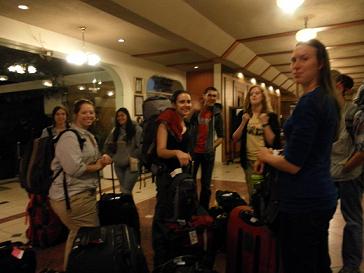
At Nairobi checking into our hotel, exhausted.


Plane to TBI!


Super excited to reach our final destination.


The breathtaking view from our cafeteria.


Most of us have abandoned our bedrooms to sleep on the breezy verandas.


Until next time!

Tuesday, September 6, 2011

TWO MORE DAYS!

Hi all! Welcome to the Turkana Basin study abroad blog! I can’t believe I’m doing this or saying this but in approximately two days I will be boarding a plane from JFK to Kenya for two and a half months! I don't know about you but summer sure went by fast for me and next thing I know I am here worrying if I have enough socks for Kenya hah. Before I go though, I thought I should drop by and write an entry to tell you guys little bit about the process of applying to study aboard (also I really need a break from packing.) I know for sure that before I applied I had TONS of questions, so in case there is anyone out there reading this and is considering study abroad, I hope this is somewhat helpful. But first, let me introduce myself.

My name is Hui (I know it says Benjamin on the right side but it should be updated any day now...) and this is my fifth year at Stony Brook University (that makes me a super senior). I am an Anthropology major and an international studies minor, and I love learning about different cultures and how humans came to be and got to be where we are. I find human prehistory fascinating and somehow learning about it in class just wasn't enough, which is why I am going on this program. I want to study human prehistory first hand in a place rich in fossil records and Turkana Basin is the place to be. Also interesting is that the Turkana Basin Institute is located in the middle of nowhere which can be scary or exciting depending on how you feel, but for anyone interested in studying human evolution like me, the Turkana Basin is an open textbook... but thankfully a much more interactive and exciting one.

Anyways, here is a map showing where the Turkana Basin is courtesy of Google Maps, except the location is so remote that even Google couldn't zone it on it hence the DIY mark I made:

Now if you are thinking about applying to study abroad and specifically to Kenya, please feel free to ask me any questions. I know studying abroad sounds like an exciting thing to do but I know it can also seem a bit mysterious if you haven't done it before. By the way, this is my second time studying abroad so trust me when I say apply early because there is a lot of paper work that needs to be done before going anywhere. These things include: filling out your application (which can now be done online), getting recommendations from your professors, going to your doctor’s to get your medical forms filled out, getting travel vaccinations and medications if your destination requires them, applying for financial aid if you need it, getting your visa, booking your flight, paying all your fees before you go, registering for classes, making copies/scanning your passports and other important documents, making sure you have signed all your paperwork, and finally buying any special things you may need for your trip.

Now I know this sounds like a lot, but that is why I recommend applying early that way you can do them without feeling overwhelmed, but once it is done you will be so glad you did!

Speaking of preparations, I better go finish packing! Will update once again when I'm in Kenya!

Notice how I have duct tape in my suitcase? What's it for? I don't know, but I'll let you know once I find it out.

Wednesday, April 27, 2011

Out of Africa...


I think that this post has been so long delayed for one important reason, and that is that I do not wish it all to be over. I do not pride myself of the fact that I descend into a nostalgic trance now that I have returned to the states, but that has often been the case. A lifetime seems to have passed in the blink of an eye. It is difficult to write about Kenya now, as it seems so far away, and yet not a day goes by that I don't think about my time there. And when I do, I can't help but smile.
Like I was at the beginning of every post previously, I am once again overcome by the the daunting task of describing my experiences, much less giving them proper justice through my description. After leaving TBI, I and a few others, traveled a bit in the south of Kenya. After staying in Nairobi, we went on safari in Tsavo East National Park and we saw elephants. Lots and lots of elephants. We didn't just see elephants. We nearly had them trample us in our tents, charge us in our car and walk right through our camp. This is on top of the baboons and vervet monkeys steeling our bananas and the lions roaring within earshot of our tent. It was absolutely wonderful! The Kenyan coast was spectacular. After safari, staying near Mombassa afforded us the most spectacular view of the Indian Ocean, while allowing us to eat fresh seafood every night and go snorkeling whenever we wanted. The amazing thing was, comfortable seaside lodging and delicious food added up to no more than about twelve dollars a day.
My return to the states was, and continues to be, difficult. All of the familiar sights and sounds are lost to me here. I miss the sunrises. I miss sitting in the cool evening air watching the sunsets over the hills every night. I miss the sand and the sun. I even miss the heat. It would be an understatement to say I have experienced culture shock upon my return here. Everything seems, at the least, slightly more than necessary. Television, billboards, concrete sidewalks, tall buildings, cars. The noise of it all can be defining. I am comforted by the knowledge that I will return to Africa and that I take away from it knowledge I could not have acquired otherwise. Both the knowledge of human evolution and ancient prehistory in Africa, and the personal affinity towards Africa that I have gained, give me pause when I hear things like "this really was a once in a lifetime opportunity wasn't it?" To that I say absolutely not. This is a lifetime opportunity. One that I expect to influence me for the rest of my life.

With that I say Asante Sana, Ejoka Noi, and Thank you. It has been my pleasure.


Sunday, March 20, 2011

Preparing to leave, but not really wanting to.

As I find myself hoping more and more that we can stay longer, our departure seems to be approaching faster and faster. It is less than a week now untill we leave TBI and it seems that we only just arrived. Time has moved faster for me here than anywhere else previously. The experience has been, to say the least an exceptional one. We have been very fortunate in our stay here. We are in the middle of a semi-desert, little visible foe miles other than sand, sparse vegetation and the most durable and resourceful people imaginable and yet here we sleep in comfortable beds. Here we have no shortage of pure running water. Here we are served three solid meals a day, most of which have been the most delicious and satisfying meals I have ever had the pleasure of eating. Rice. Ugali. Ox tail stew. Grilled chicken. Tilapia grilled and baked. Grilled thinly sliced steak with a creamy pepper sauce, green beans and mashed potatoes. Fresh fruit including pineapple, mango, papaya, and peaches. Steamed pudding with jelly, baked apple crisp and chocolate ice cream. Chocolate ice cream. Once more for effect, Chocolate ice cream! In the middle of the desert! Need I say more?
It has not just been about food. Our courses have been fantastic. The one that we are currently in, "Invertebrate Paleontology of the Turkana Basin" is another valuable learning experience. We have had a detailed introduction to fossil identification and morphology (shape). Teeth, as they are the most durable part of the body, are invaluable for identifying species and species change over time and we have learned a great deal about their morphology and identification. I have had a great time going out into the field and being able to identify a fragment of a fossil, simply by observing its teeth. I recently discovered the buried jaw of an enormous herbivore. Unfortunately we weren't able to excivate, but you could see that it was either a hippo or a pig, that it was a juvinile, with its teeth still deep in the bone, and that it was enormous. It is simple identifications like these that allow for some of the most important identifications of finds. This course has really given me an invaluable understanding of fossils, and the nature of fossil collection and identification. It is not over yet though, and I look forward to excavations next week. We leave on Saturday, so I will deffinately get one more post in before we do. Until then, my very best regards from this fantastic place!

Wednesday, March 16, 2011

Turkana Wedding and Ancient Pillars

As I said we would, we did end up going to a Turkana wedding last week. I was a little curious of how we would be received at this event, as subtlety is never something we as a group, are very good at when traveling. In simply driving around, it can be difficult to guess what peoples reactions may be. There are times when we are met with an intense curiosity. Other times, we seem to inspire an overwhelming excitement, or silliness, because people have on more than one ocasion collapsed in side splitting laughter upon seeing us. On still other and fortunately less frequent occasions, the Turkana seem to want absolutely nothing to do with us, shouting and shooing us away as we pass. Fortunately when we arrived at the wedding, a week long event making it fair to say that we arrived for only a very small portion of it, we were well received. The dances taking place here were considerably more elaborate than any we had previously seen. First, a group of ornately decorated and topless (unthinkable in the west, but here entirely unremarkable) women danced up to us, and welcomed us in their own way. From then on, although I am sure that there were other things happening related to the wedding itself, we danced. Some of us danced for only a short while while others, myself included, continued for the rest of our time there. It was a long process, involving a rhythmic stamping and continuing enactment of stories. The men would chant to a vague tune, as one would run around the circle blowing his whistle and another might mime the firing of a gun. Once or twice I tried my hand at jumping into the circle in a sort the mocking challenge they often did, much to the laughs and enjoyment of everyone else. Another move involved jumping out and startling the women who could be found encircling all the men. Before I knew it, it was time to leave, and I was a bit exhausted. These dances often go on for many hours at a time, with much sitting and standing back up to build the excitement and the hype. I was done, but the dance obviously wasn't and was certainly going to continue for a long time after we left.
On a less exhausting note, we finished our archaeology module, after having learned a great deal about human behavior, tool use and more. In the last week, we visited a number of Impressive burials containing massive stone pillars. These pillar sites were created by pastoral peoples as cemeteries, but as for the exact motivations and methods, archaeologists are stumped. They are nearly two thousand years older than Stonehenge and are therefor some of the earliest examples of megalithic architecture in the world. Our time here is coming to a close. More and more we are having to make preparations for our return and it is sometimes sad. Still, I still have a few more posts to do and I look forward to doing them.

Saturday, March 5, 2011

Goat Butchering, Stone Knapping and Excivation

Well, There I was, elbow deep in goat entrails removing the skin with a small sharp stone flake, and having a blast. Now this would certainly disgust many people back home, and I must admit that the idea of it is not particularly enticing, but there I was anyway. I do not need to go into to a very detailed description and this is probably a moment where I do not regret the inability to share photos with you. It is enough to say that we butchered a goat, start to finish, using only the simple stone flakes that we ourselves made. It was not easy, but at the same time I was surprised by the cutting edge of these flakes, the material of which ranged from basalt, which in this case was very grainy and hard to flake, to chirt, which had a smooth and longer lasting cutting edge. I felt very deeply that the process not only put the lives and diet of stone age peoples into perspective, but also that of our own. In the west, we have lost touch with our food. We eat huge amounts of meat, and do not even realize where it comes from. Here, I have seen the process unfold start to finish. The meet I helped butcher, cook and eat last night was only a few hours earlier walking around having lived a cage free and humane life. I feel that here it is possible to have a level of respect for the consumption of meet and the whole process of its production, that we have completely lost back in the states and other industrialized countries.
The reason that we were doing all of this was of course for our archaeology course with Veronica Waweru and Helen Roche. So far in this course, we have had a good introduction both to concepts and practical applications of stone tool production, as well as site excavation at lake Aiyangyang. this course has also been, for me, one of the most rewarding because it is the field that I personally have the most interest in. It has been a great learning experience making, and especially using, stone tools and I hope to continue to learn about the subject when I return home.
Tonight, we are planning to attend a Turkana Wedding, and I have no doubt that it will be an interesting experience. We have, over the past weeks, been as curious about the Turkana as they sometimes seem to be about us. The only difficulty can be that it is easy to offend and we don't want to impose ourselves, which is difficult not to do when you arrive in the largest vehicle for miles and are quite obviously not local. I hope to write again soon, Kwaheri !

Tuesday, March 1, 2011

Paleoenvironments "Lucy" and Ice Cream.

Now, one may ask ones self what exactly these three things mentioned in the title of this post have to do with one another. A paleoenvironment is a past environment reconstructed to put into perspective our world climate and also to put into context past hominids like "Lucy". "Lucy" of course is the famous Australopithocene discovered in 1973, and remains one of the most complete hominin skeletons discovered, and ice cream is a delicious frozen treat often best served with pie (in this viewers humble opinion, warm apple pie).
Our most recent class was on reconstructing ancient environments. This was taught by Raymond Bonnefille, and although it was less field trip intensive than our other classes, we none the less learned a great deal. Although it is a very difficult field to study and reconstruction of past climates is not always straight forward, Raymond was able to present the course with style and ease, which is saying something considering she is french the vast majority of her work is in french
We were were lucky enough to have a surprise visit from Dr. Donald Johanson recently, and he was a very informative person to talk to. He discovered "Lucy" at Hadar, Ethiopia in the 1970s. It is of special importance, due to the fact that he and Richard have not spoken in many years, due to academic disagreements and the like, and have been able to put these aside here. It really goes to show that the future of the field and a place like this, are to precious to let these disputes get in the way of either one. We were really quite fortunate to have him speak to hear briefly about the discovery and his work. Apparently, Lucy got her name because the Beatles were playing on the radio at Hadar, and "Lucy in the sky with diamonds" came on, the name was suggested and it stuck.
Lastly, but most certainly not least, is the ice cream. Richard surprised us when he returned from Nairobi, with homemade (and when I say this, I mean Richard Leaky made, for he is an excellent cook) chocolate ice cream. We have been extremely lucky with the food here. It has been delicious and wonderful in every sense, but especially when Richard is in the kitchen cooking. He can often be found there causing delicious smells to drift throughout camp. Interestingly enough, as I was just reciently writing about Ice cream, I was drawn away from the computer and surprised to find a late dessert waiting in the mess hall. Meave had baked us steamed pudding, with strawberry jam. This was like a delicious bunt cake fresh out of the oven and as tasty as any other cake I have ever eaten.
So here I am, having the time of my life, making good friends and eating unbelievably delicious food. I can imagine nowhere I would rather be.