Sunday, October 23, 2011

Four more weeks!!

Hi all! Happy Sunday! It’s been a long week here for us at TBI. We just finished our presentations and exams for our Paleontology class yesterday so everyone is really happy to be able to finally relax. Throughout the week, we went fossil hunting again and in one site we got to do a little bit of excavating and sieving. Sieving is a way of putting soil/sand into a net to pick out small fossils that might be missed by the naked eye. We all got really dusty and a bit sun burnt on that day but otherwise everyone had a lot of fun and is well and happy.

Sunday is a special day here for us all because it is the only day we get off, and you may wonder what DO we do around here on Sunday? Well it depends. Sometimes we go into town to restock on snacks, sometimes we go on mountain hikes, sometimes we go swimming by the lake, and on one weekend we even went into town to help plant some trees in remembrance of Kenya Nobel Prize winner, Wangari Maathai, so you can see aside from academic activities we also get exposed quite a bit to the local culture here. Interesting note, most of the locals here are Christian so a lot of the stores in town are closed on Sundays.

As for today I just decided to stay behind and relax with two other TBI students, and when the other students came back from town with the traditional kikoy cloths we couldn’t resist getting dressed up and getting lots of pictures. For those pictures please refer to fellow blogger Roy Lots’s post regarding today, and while you’re there Roy also has a fascinating interview with one Linkof our TBI staff members that’s well worth of reading (you can find his page here ).

Picture time!


TBI students and Meave Leakey at Esha, a late Miocene site.


Students hovering over a sieve to pick out fossils.


Students sweeping the floor for fossils and sand to put into sieve.


Students celebrating rain!


Until next time! :)


Saturday, October 15, 2011

Hi all! It’s been awhile but exciting things have happened since my last post. First of all, it has been raining here randomly the past three nights and temperature has gone down quite a bit because of it. I’m actually wearing a long sleeve sweat shirt as I’m writing because it’s a bit chilly. The rain was definitely a surprise for most of us and when it did rain we all woke up in the middle of the night to take it in. Second, we are now moving along into our third module: Paleontology and Ancient Environments of the Turkana Basin with Rene Bobe, Meave Leakey and Fredrick Manthi who have all been keeping us busy with class. A lot of material is covered in this class since it is taught by three people and we are all trying very hard to absorb all that is being taught. Rene Bobe especially is teaching us all sorts of things about animals, from their evolutionary history to what they eat to every bone in their body; I’m proud to say I now can identify most bones on many animals, which is something I had little knowledge of before this. We have also gone fossil hunting twice now and on our second trip I’ve had the luck of finding the teeth of an extinct giraffe specie named sivatherium, which is said to be the first of its kind found here at South Turkwell, another hooray!
Since we didn’t really go anywhere too far recently I thought I could tell you guys what a typical day is like here at TBI. Here is a schedule of a regular class day;
7-7:30am- wake up
8am- breakfast
8:30am- 12pm – class with tea and biscuits somewhere in between
12pm- 3:30pm – lunch/break/nap
3:30 – 5pm or 6 – class/lab/study
5:30 – 8:00 – break/study/shower (sun sets at 7pm)
8:00 – dinner
10pm/11pm- sleep
So there you go, that’s how we spent most of our days here when we are not going out. We usually take a big break after lunch because it gets very hot in the afternoon, and since there is no air conditioning it’s very hard to concentrate so we resume class at 3:30 when things cool down a bit.
Here are some pictures of us going about in our daily activities:

Fossil hunting with Meave Leakey.

Removing sand/soil off of fossil.


Sivatherium (an extinct giraffe-like specie) found on erosion surface 3 days ago.


Students examining different bones of animals.


A typical lunch at TBI.

Students enjoying lunch after spending the whole morning outside.


Students in class.

Skulls at the TBI lab.


Tuesday, October 4, 2011

Ecology of the Turkana Basin with Dino Martins

Hello everyone, a lot has happened since I last posted. After our trip to Lothagam we wrapped up our Geology module with a test and a trip into town to Lodwar that weekend. There we said good bye to our professor, Craig Feibel who normally teaches at Rutgers, and explored a bit of town. Like most town centers, Lodwar is where all the stores are, where people come to buy food or sell food, where people come to see the doctor, where the bank is and so on. We had an interesting time there buying local snacks and received quite a good amount of attention since we stood out so much from the locals.

The following week, we began our second module, Ecology of the Turkana Basin with Dino Martins and so far we’ve been having a blast. When we’re not in class, Dino has us running all over the place observing and catching all kinds of insects and plants. I think I might have learned more about bugs and plants here in the past week than I have in all my twenty-two years of schooling (that’s what happens when you grow up in the city). Bees for example, are extremely fascinating insects with very complicated lives, who knew?

Other highlights of these past two weeks;

1. According to Dino, we caught parasites and bees that have never been studied so far.

2. We climbed the Napodet Hills, which is a series of hills about an hour away from TBI.

3. We all started our own projects for our ecology class; mine explores how rainfall affects the Turkana region, others have taken up to studying the decomposition of animals, ants that live in hot climates, the pastoralist community around here and etc.

4. We explored the Kerio River Delta and made some new friends.

5. We visited a nearby farm to learn how a small group of women have taken up to sustainable farming, and then sung songs for them.

Till next time! :)


Saturday, September 24, 2011

Central Island and Lothagam

Duct tape use #1- mending mosquito nets

Duct tape use #2- fixing broken eyeglasses

Two trips have happened since the last time I wrote; one was to Central Island and the other to a place called Lothagam.

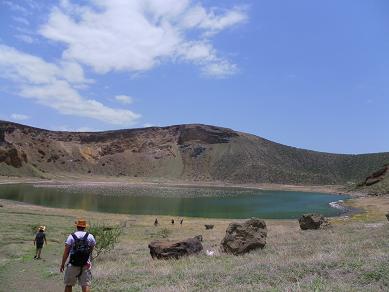
Central Island, as I have mentioned in the previous post is an island located in the middle of Lake Turkana and use to be a volcano. Today however it is a mountain full of volcanic deposits and craters and is home is several species of animals. One of the craters we visited was taken over by flamingoes, which I have learned are very pretty to look at but not so great to smell. Another animal that resides on this island are crocodiles and luckily for us, we spotted two of them in the lake, but instead of being scared we decided to jump right into the lake. You think we’re crazy but if you were standing under that hot sun, you’ve done the same. Plus, those crocodiles know humans were nothing but trouble.

Our second trip was to Lothagam, and our main purpose there was to learn about the geological structures there that date from the Miocene (approx. 23 million years ago) to today. There we did a lot, I mean A LOT of walking and hiking till the point that I was sweating in places I never knew I could sweat. Imagine hiking in a big sauna. On our hikes we saw many exciting things such as mysterious human burials, stone tools, fossilized giraffe footprints, hyena tracks, oysters, bones of humans and various animals and more. I have also learned that walking in sand is very difficult and not fun for those who like to walk fast like me. When we were not hiking and learning we rested in our campsite under a bunch of palm trees. There we sipped tea and coffee with biscuits, and talked about anything and everything that came to our minds, something I enjoy very much. At night we slept under the open sky and although it was so hot that I couldn’t sleep, I didn’t mind it so much because I was too busy looking all the stars. Have you seen the milky way? I wish I could take a picture of all the stars here and show you guys but it seems my digital camera just won’t do. Anyhow it is about lunch time here so here are some pictures of these past few days, enjoy.


Central Island


'


Lothagam


Friday, September 16, 2011

It's a dry world.

Hi all! It’s BLAZING hot here today at TBI. I don’t know the exact temperature conversions (Kenya uses the Celsius system) but I know we are definitely well over 100 degrees Fahrenheit here. To give you an idea, I drank over 3 litres of water today and a nap in the afternoon left me soaked in sweat. However, class continues here hot or well, hotter. Class started this Monday, and we’ve done a variety of things since then including going to the outskirts of the camp to explore the landscape, going down by the river and crossing it and getting lost during one of our class activities. Turns out, I did not know how to read the compass as well I believed…but now I know. In addition, we have also learned how to use GPS devices, how to measure elevations with simple instruments and how to calculate the flow of water in rivers. All in all, these lessons have been very educational but also very valuable if I ever got lost in the middle of nowhere.

Today is the fifth day of class but surprise; it’s not the last of the week because here we also have class on Saturdays. No fear though because we’ve been assured that tomorrow will be a fun filled day out of the camp. We will be going to the lake and not only around it but we will actually get on a boat and get to an island in the middle of it, which is actually the tip of a volcano turned mountain. Not bad for a Saturday huh?

Here are some pictures of various happenings from the past few days:


P.S You can find TBI on Google Earth but you have to spend a good few minutes scanning the west area of Lake Turkana.